


Global Perspective: Is Globalization Dead?
The latest round of tariffs announced by the U.S. government in early April sparked sharp criticism from world leaders, some even suggesting that globalization is dead. What follows is my take on this topic. I like to look at the facts before passing judgment, and I am happy to say that globalization isn’t dead – it’s evolving.
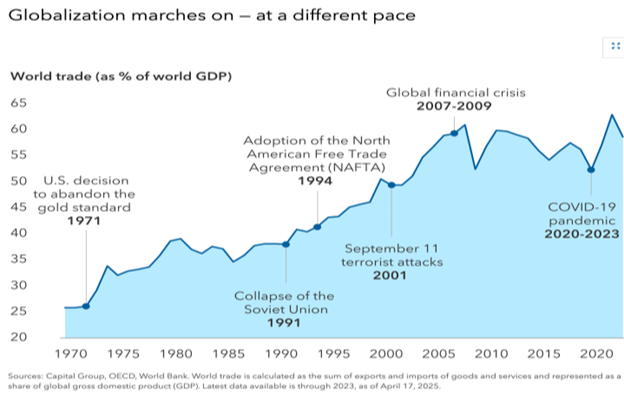
It’s true that we may be entering a new phase. There are valid reasons for globalization to undergo a policy and structural refresh, particularly the model we’ve known since the 1970s, when global trade expansion surged. In fact, the global trade landscape has been shifting for years.
While recent developments feel seismic, it’s worth noting that global trade as a percentage of world GDP has moved mostly sideways since the global financial crisis of 2007–2009.
More recently, events such as the COVID-19 pandemic and the Russia–Ukraine war revealed deep vulnerabilities in global supply chains, particularly the dangers of overdependence on single trade routes or regions. These events didn’t end globalization, but they did expose its blind spots and have accelerated the move toward more resilient, diversified supply chains.
In this new era, global interconnectivity will continue—but it may look more regional, more strategic, and more intentional than before.
Globalization 2.0: A New Path Forward
In the years since the pandemic and war in Ukraine, nations and corporations alike have taken decisive steps to diversify supply chains. Many are reshoring or near-shoring critical manufacturing to ensure greater economic resilience.
While it’s unlikely the U.S. will return to its former status as a global manufacturing powerhouse, we do expect greater self-reliance—especially in strategically vital sectors such as semiconductors, pharmaceuticals, and medical equipment.
The U.S. government’s actions—though sometimes jarring to investors—clearly aim to reshape global trade rather than retreat from it. This is the dawn of what we might call Globalization 2.0: a more balanced, diversified, and strategically regionalized system of international trade.
This vision is already taking shape. Apple recently committed $500 billion to new U.S. operations over the next four years. Taiwan Semiconductor is expanding into Arizona, Germany, and Japan. Dutch chipmaker ASML now operates across 60 international offices with over half its workforce outside the Netherlands.
Investment Opportunities Amid Trade Shifts
Despite today’s volatile headlines, I remain optimistic. Over the course of my 43-year career, I’ve experienced more than twenty market shocks. In hindsight, many of those periods turned out to be excellent entry points for disciplined, long-term investors.
We believe the global economy isn’t closing its doors—it’s simply being redesigned. As trade policies evolve, new opportunities will emerge across sectors tied to infrastructure, energy, technology, logistics, and domestic manufacturing.
Yes, the road ahead may be uneven. Markets may react sharply to headlines. But as long as the goal remains strategic globalization, not isolationism, we believe the investment outlook remains constructive for those with a long-term view.
As with the 5 keys to 2025 investing, globalization will be a theme for us to follow and profit from. Stay the course for now because a new era of investing will begin mid-year.
"This material is provided for general information and is subject to change without notice. Every effort has been made to compile this material from reliable sources however no warranty can be made as to its accuracy or completeness. The information does not represent, warrant or imply that services, strategies or methods of analysis offered can or will predict future results, identify market tops or bottoms or insulate investors from losses. Past performance is not a guarantee of future results. Investors should always consult their financial advisor before acting on any information contained in this newsletter. The information provided is for illustrative purposes only. The opinions expressed are those of the author(s) and not necessarily those of Geneos Wealth Management, Inc."